
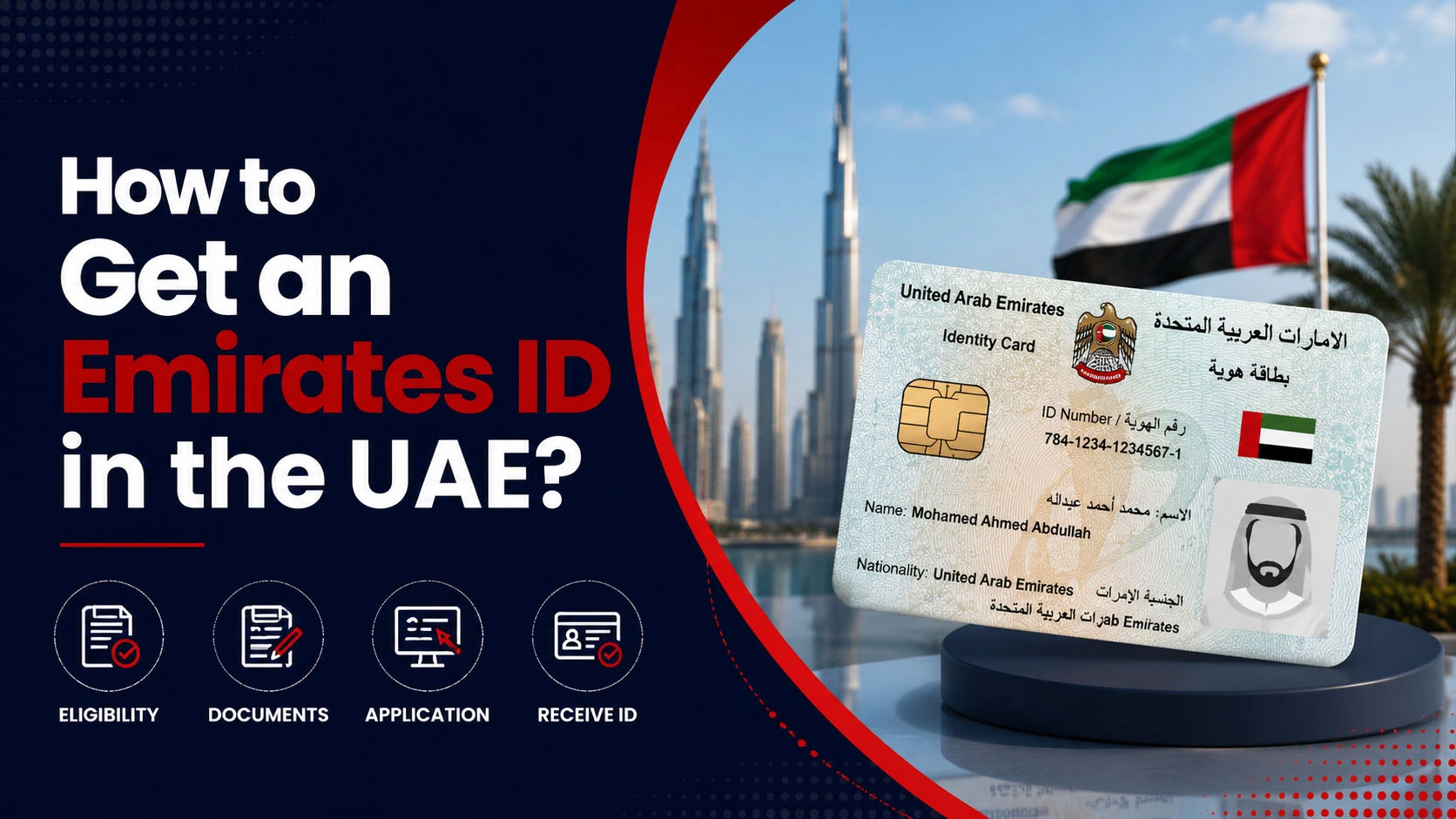
This 2026 guide walks every UAE resident, expat, investor, and family visa holder through obtaining, using, and renewing the Emirates ID.
If you live, work, study, or invest in the UAE, the Emirates ID is the single most important document in your daily life — more important, in many practical situations, than your passport. It identifies you to the government, lets you access banking, healthcare, telecom, and travel services, and serves as the digital backbone of the country’s smart government ecosystem. Without a valid Emirates ID, almost no formal transaction in the UAE is possible.
For new residents, the process can feel confusing — entry permits, medicals, biometrics, status checks, and renewal cycles all overlap. For long-term residents, knowing how to renew correctly, replace a lost card, or update personal details makes the difference between a smooth life and constant paperwork friction.
This guide explains how the Emirates ID system works in 2026, who needs it, how to apply step by step, what it costs, and how to keep it valid throughout your time in the UAE.
What Is an Emirates ID?
An overview of the Emirates ID — the official UAE identity card issued to every legal resident.
The Emirates ID is the official national identity card issued by the Federal Authority for Identity, Citizenship, Customs & Port Security (ICP) — formerly the Federal Authority for Identity and Citizenship (ICA). It is mandatory for every UAE citizen and resident, regardless of age, nationality, or visa type.
Key features:
- A unique 15-digit identification number (IDN) used across all government and private systems.
- Embedded smart chip storing biometric and personal data.
- Acts as legal proof of identity, residence status, and visa eligibility.
- Used for digital signing, e-government access, and UAE Pass authentication.
- Doubles as a travel document for GCC nationals within the GCC.
Why it is mandatory: Without an Emirates ID, you cannot open a bank account, sign a tenancy contract, register a SIM card, access public healthcare, enrol in school, or process most visa-related transactions. It is the de facto operating system of life in the UAE.
Who Needs an Emirates ID in the UAE?
An outline of the residents, citizens, and visa holders who are legally required to hold one.
- UAE nationals. Mandatory from birth, renewed every 5 to 10 years depending on age.
- Expat employees. All employed residents must hold a valid Emirates ID linked to their work visa.
- Investors and business owners. Required for company shareholders, partners, and trade license holders.
- Family visa holders. Spouses, children, and dependants sponsored by UAE residents must obtain one.
- Students. University students on study visas require an Emirates ID for campus and government services.
- Domestic workers. Household employees sponsored under a domestic worker visa must also be registered.
- Retirees and Golden Visa holders. All long-term residency visa categories require an Emirates ID.
- GCC nationals. Residents of the wider GCC can register for an Emirates ID for ease of access to services.
Benefits of Having an Emirates ID
The everyday advantages an Emirates ID delivers across personal, financial, healthcare, and government interactions.
- Identity verification. Accepted as the primary ID by all government departments, banks, and private businesses.
- Access to government services. Required for visa renewals, MOHRE transactions, traffic services, and court matters.
- Banking transactions. Mandatory for opening accounts, applying for loans, and conducting large transactions.
- Healthcare services. Used for medical insurance verification, hospital registration, and pharmacy purchases.
- Telecommunications registration. Required for SIM cards, broadband, and TV subscriptions.
- Smart government services. Acts as the credential for UAE Pass, the country’s digital identity platform.
- Travel within the GCC. Eligible GCC nationals can use Emirates ID instead of a passport for GCC travel.
- Property and tenancy services. Required for Ejari registration, mortgage applications, and utility connections.
Eligibility Requirements for an Emirates ID
The basic eligibility conditions an applicant must meet before applying for an Emirates ID.
- Valid residency status. Applicants must hold a valid UAE residence visa or be a UAE/GCC national.
- Valid passport. A passport with at least 6 months of remaining validity is required.
- Approved visa category. Work, investor, family, student, retirement, or Golden Visa holders are all eligible.
- Supporting documentation. Birth certificates (for children), marriage certificates (for spouses), or sponsorship letters where applicable.
- Medical fitness clearance. Required for applicants aged 18+ on most residence visa categories.
Documents Required for Emirates ID Application
The full list of documents needed by different applicant categories when applying for the card.
| Applicant Type | Required Documents | Additional Requirements |
|---|---|---|
| UAE National | Family book, passport copy, recent photo | Birth certificate (for children) |
| Expat Employee | Passport, residence visa, work permit, photo | Medical fitness certificate |
| Investor / Business Owner | Passport, investor visa, trade license, photo | MOA or shareholder documents |
| Family Visa Holder (spouse/children) | Passport, residence visa, sponsor’s Emirates ID, marriage/birth certificate | Attested supporting certificates |
| Student | Passport, study visa, university enrolment letter, photo | Sponsor or guardian details |
| Domestic Worker | Passport, residence visa, sponsor’s Emirates ID, photo | Medical fitness certificate |
| Golden Visa / Long-Term Resident | Passport, Golden Visa, eligibility certificate, photo | Supporting evidence of qualification (investment, talent, profession) |
How to Get an Emirates ID in the UAE
A clear step-by-step walkthrough of the full Emirates ID application process for new applicants.
Step 1 – Obtain a UAE Residence Visa
Apply for and receive your UAE residence visa under the appropriate category — employment, investor, family, student, or Golden Visa. The Emirates ID application is tied to this visa.
Step 2 – Submit the Emirates ID Application
Apply online via the ICP portal or app, or visit an authorised typing centre. The form captures personal data, visa details, and biometric appointment preferences. Fees are paid online.
Step 3 – Complete Medical Fitness Testing (if applicable)
Adults applying for a new residence visa undergo a medical fitness test at a government-approved centre. The medical typically includes blood tests and a chest X-ray to confirm fitness.
Step 4 – Complete Biometrics Registration
Visit a designated ICP service centre to record fingerprints, facial recognition data, and a digital signature. Bring your passport, visa, and application receipt. The process takes 15–30 minutes.
Step 5 – Application Processing
The ICP processes your file, validates biometrics, and prints the card. Standard processing takes 5 to 10 working days. Expedited “Fawri” service is available for urgent applications, often within 24 hours.
Step 6 – Receive Your Emirates ID
The Emirates ID is delivered to your registered Emirates Post address or collected from an authorised centre. Once received, verify all printed details before signing the card.
Emirates ID Biometrics Process
What to expect during the biometric capture stage of your Emirates ID application appointment.
- Fingerprints. All 10 fingerprints are scanned to ensure unique identity matching.
- Facial recognition. A high-resolution photo is captured for the chip and ID printing.
- Digital signature. A specimen signature is captured electronically and embedded into the smart chip.
- Registration centres. ICP runs dedicated centres across all seven emirates. Most allow online appointment booking.
- What to expect. Bring originals of your passport and visa, application reference number, and arrive 10 minutes early. The process typically completes in under 30 minutes.
Children under 15 are exempt from fingerprinting. Senior citizens with medical exemptions can request mobile or home-based biometrics in select cases.
Emirates ID Fees in 2026
Emirates ID application and renewal fees are based on a card issuance fee of AED 100 per year of visa validity, plus an electronic application fee of AED 40. A snapshot of the official fees applicable to new applications, renewals, replacements, and expedited services.
| Service | Fee (AED) |
|---|---|
| New Emirates ID application (1 year) | 100 |
| New Emirates ID application (2 years) | 200 |
| New Emirates ID application (3 years) | 300 |
| Application/typing centre service fee | 70 – 150 |
| Expedited “Fawri” service | 150 (additional) |
| Renewal fee (1 year) | 100 |
| Renewal late fee | 20 per day (capped at 1,000) |
| Replacement (lost or damaged card) | 300 |
| Knowledge & innovation fee | 20 |
Fees vary slightly depending on visa category and validity. Always confirm the latest official rates before paying.
How Long Does It Take to Get an Emirates ID?
An overview of standard and expedited processing timelines for new applications and renewals.
- Standard processing: 5 to 10 working days after biometrics are completed.
- Urgent (Fawri) service: 24 hours or same-day issuance at select ICP centres.
- Factors that affect timing: Visa approval delays, biometric scheduling, document accuracy, and ICP backlog during peak seasons.
For business owners under pressure to open bank accounts or sign contracts, expedited Fawri service is often worth the additional fee. BizInvestFirm regularly helps investors prioritise this step when timing matters.
How to Check Emirates ID Status
The simple steps and tools available for tracking the progress of an Emirates ID application.
- Online tracking. Use the ICP website or app and enter your application or PRAN (Pre-Registration Application Number) reference.
- SMS updates. ICP sends automated SMS notifications at each major stage of processing.
- Common status updates:
- Under Process — application accepted and being reviewed.
- Approved — biometrics and documents cleared.
- Printed — card has been produced.
- Dispatched — Emirates Post has shipped the card.
- Delivered — card received at the registered address.
Emirates ID Renewal Process
The four-step process every UAE resident should follow when their Emirates ID is approaching expiry.
Step 1 – Prepare Required Documents
Have your current Emirates ID, valid passport, and updated residence visa ready. If your visa is also expiring, renew it in parallel.
Step 2 – Submit Renewal Application
Apply online via the ICP portal or app, or through an authorised typing centre. Most residents can complete renewal entirely online.
Step 3 – Pay Applicable Fees
Pay the renewal and service fees online. If your card has already expired, late fees of AED 20 per day apply, capped at AED 1,000.
Step 4 – Receive Renewed Emirates ID
The renewed card is delivered through Emirates Post or made available for pickup. Biometrics are usually not required on renewal unless requested.
Lost or Damaged Emirates ID – What to Do?
What to do if your Emirates ID is stolen, lost, or physically damaged and needs a replacement.
- Reporting procedures. Report the loss immediately through the ICP portal or visit an ICP customer happiness centre.
- Replacement process. Submit a replacement request with your passport, visa copy, and a police report (in some cases of theft).
- Fees and timelines:
- Replacement fee: AED 300 plus knowledge fees.
- Service centre charges: AED 70 – AED 150.
- Standard processing: 3 to 5 working days.
- Expedited Fawri service: 24 hours.
Until the replacement arrives, you can use the digital Emirates ID via UAE Pass for most government and banking services.
Common Mistakes to Avoid
The most frequent errors residents make during the application, renewal, and updating of their card.
- Incorrect application details. Misspelled names, wrong date of birth, or mismatched passport numbers cause rejections and reprint fees.
- Delayed renewals. Late renewal fees accumulate at AED 20 per day. Renew at least 30 days before expiry.
- Missing documents. Forgetting medical reports, sponsor IDs, or attested certificates is the leading cause of application delays.
- Ignoring status updates. Missed SMS notifications can delay biometrics or collection, extending overall timelines.
- Failure to update personal information. Marital status, address, or employment changes must be updated promptly to avoid record mismatches.
- Using uncertified typing centres. Always use ICP-approved centres or trusted PRO services like BizInvestFirm to avoid invalid submissions.
- Lost cards left unreported. Failure to report a lost ID can expose you to identity misuse risks.
Why the Emirates ID Is Important for Business Owners and Investors
How the Emirates ID supports core business operations, licensing, banking, and compliance activities.
- Business licensing. Required for company formation, MOA signing, and trade license processing.
- Banking. Mandatory for opening corporate accounts and signing facility agreements.
- Residency management. Linked to your investor visa and any visas you sponsor for staff or family.
- Government transactions. Used for MOHRE labour contracts, immigration services, customs registration, and free zone portals.
- Corporate compliance. UBO declarations, VAT and corporate tax registrations, and ESR notifications all reference the Emirates ID number.
- Digital signing. UAE Pass — linked to your Emirates ID — enables legally valid e-signatures on contracts and government forms.
Conclusion
A summary highlighting why a valid Emirates ID is essential for personal, financial, and business life in the UAE.
The Emirates ID is far more than a plastic card — it is the foundation of your legal and digital identity in the UAE. From opening a bank account and signing a tenancy contract to launching a business, registering for VAT, or sponsoring your family, virtually every meaningful interaction in the country starts with your Emirates ID. Keeping it accurate, valid, and up to date is not just a regulatory requirement; it is a practical necessity for a smooth life and business in the UAE.
The application process itself is straightforward once you understand the sequence — visa, application, medical, biometrics, processing, delivery. The real friction comes from missed renewals, incorrect data, or last-minute applications under business pressure. A small investment in professional support pays for itself many times over in time saved and delays avoided.
Get Expert Visa, Residency & Emirates ID Support With BizInvestFirm
Discover how BizInvestFirm can simplify your UAE visa, residency, Emirates ID, and business setup journey efficiently.
BizInvestFirm is a trusted provider of UAE visa, residency, business setup, and government documentation services — helping individuals, families, investors, and companies obtain and renew their Emirates IDs without paperwork headaches. From new residence visa processing and medical coordination to biometrics scheduling, Emirates ID renewals, and PRO services, BizInvestFirm manages every step end-to-end.
From company formation and licensing to long-term visa management and government documentation, BizInvestFirm offers a complete back-office stack under one roof. One dedicated consultant. Transparent fees. Zero surprises.
For additional official information on Emirates ID services, visit the Federal Authority for Identity, Citizenship, Customs & Port Security (ICP).
Frequently Asked Questions
Most common questions about Emirates ID applications in the UAE.
1. What is an Emirates ID in the UAE?
The Emirates ID is the official national identity card issued by ICP to every UAE national and resident. It is used for identity verification, government services, banking, and healthcare across the UAE.
2. Who is eligible to apply for an Emirates ID?
All UAE nationals and residents holding a valid UAE residence visa — including employees, investors, family dependants, students, retirees, and Golden Visa holders — are eligible and required to apply.
3. How much does an Emirates ID cost in 2026?
Fees range from AED 100 to AED 300 for the card based on validity, plus service centre charges of AED 70 to AED 150. Expedited Fawri service adds AED 150 to the cost.
4. How long does it take to get an Emirates ID?
Standard processing takes 5 to 10 working days after biometrics are completed. Expedited Fawri service can deliver the card within 24 hours.
5. Can I track my Emirates ID application status online?
Yes. You can track the status through the ICP website, ICP UAE mobile app, or SMS updates using your application reference or PRAN number.
6. How do I renew my Emirates ID?
Submit a renewal request via the ICP portal or app, pay the applicable fees, and collect the renewed card via Emirates Post. Late renewals incur AED 20 per day, capped at AED 1,000.
7. What should I do if I lose my Emirates ID?
Report the loss immediately via the ICP portal or a customer happiness centre, then apply for a replacement with a fee of AED 300 plus knowledge fees. Replacement typically takes 3 to 5 working days.
8. Is a medical test mandatory for Emirates ID?
Adults applying for a new UAE residence visa must complete a medical fitness test at a government-approved centre. Children and certain visa categories may be exempt.
9. Can I use my Emirates ID instead of my passport in the UAE?
Yes. Within the UAE, the Emirates ID serves as the primary identification document for almost all government, banking, healthcare, and private services. GCC nationals can also use it for GCC travel.
10. Can BizInvestFirm help me apply for my Emirates ID?
Yes. BizInvestFirm offers complete visa, residency, Emirates ID, and PRO services for individuals, investors, and businesses, handling documentation, applications, and government coordination end-to-end.
